Business IntelligenceThought Leadership Traffic Analytics
Taking The Pulse Of Physical Store Trends
February 11, 2025
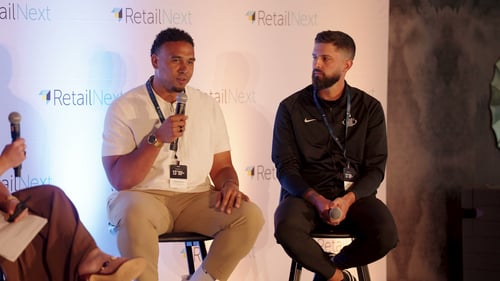
At the 2025 NRF Big Show, Joe Shasteen, RetailNext's Global Head of Advanced Analytics, presented the 2024 YoY traffic trends, focusing on festive traffic. Joe emphasized the positive performance of key shopping occasions, such as Black Friday, Easter, Mother's Day, and Super Saturday, in physical stores. He explained that since 2017, these occasions have provided remarkable spikes in store traffic, and the levels are now comparable to the pre-pandemic performance.
Moreover, we’ve tracked a large increases in shopper traffic after Christmas 2024 compared to previous years, signifying pent-up demand. Jewelry came out tops as the best-performing category in 2024 in terms of traffic, with home being lowest. Post covid, the category has struggled to recover from the lockdown-era spike compared to when people were investing more markedly in home goods and refurbishment.
Joe also presented key takeaways from our UK and US Consumer Sentiment Surveys.
KEEP WATCHING: Joe's Executive Session On Overall US Traffic Trends With Andrew Neelon
Transcript
-
Read the Transcript
Good afternoon, everybody. Thank you for joining, today's RetailNext chat around our pulse and our metrics around benchmarking within the United States as well as globally with, what we're seeing from a traffic trend perspective, regarding this metrics and last year's metrics. Just a little bit about myself and RetailNext. I'm Joe Shasteen, global manager of advanced analytics at RetailNext.
And RetailNext is the first retail vertical IoT platform to provide ecommerce style analytics to brick and mortar shoppers. Our centralized SaaS platform automatically collects and analyzes the data and provides it to retailers in real time so they can make business decisions based on data driven analysis. We are trusted by over four hundred and fifty retailers across a a hundred countries across the globe. So just to get into it a little bit.
Well, a few typical use cases that we see within this data is typically across the organization in operations, marketing, merchandising, asset protection. We can all be using these trends to understand how our stores are looking in comparison to the market and therefore try to adjust on the fly or or tweak in order to make sure that we are able to take advantage of the trends that we're seeing not only in our store, but kind of nationally as well. So just to start out getting into the US traffic trends, I wanna set the stage a little bit from the post COVID trends that we saw in twenty twenty. So as we all know, twenty twenty was a very tough year for retail.
You know, lockdowns, occupancy limits, and things like that led to fairly large declines in our traffic trends for twenty twenty compared to twenty nineteen, typically in that thirty to forty percent range, very large. However, on a slightly more positive note from that time, we did see that that sales metrics and the sales conversion as those shoppers were definitely less likely to browse and more likely to make a purchase if they were going into those stores. So that's where you really see that increase in the sales trends, which really held through most of twenty twenty one as well when we started to see the, you know, the large increase over the twenty twenty trends before we start to get into our new normal at this stage, which is in early twenty twenty two when we start to see traffic in those browsers really come back into the store where they're not always on such a dedicated journey to make a purchase, but they're actually being a little more competitive for that share of their wallet, and they have to find the right deal in order to make that purchase. So as we look a little bit more hone in onto twenty twenty four in particular, you know, we saw some pretty remarkable stability throughout the course of the year.
Very few kind of blips. Typically seeing most of our retailers seeing that decline of about, you know, three to seven percent, every week of the year with a few blips typically around the shift for Easter that we see kind of in, March and April. We did see some positivity more in that kind of early back to school period in August. And then a few times where we saw some positivity as well in October.
But then that really led into kind of the end of the year trends when we had the shift in Black Friday, which led to some differences that we normally see, when Black Friday stays in the same week. So just with some specific important holiday days this year, we did see that Black Friday, when compared to Black Friday of twenty twenty three, was down about three percent. However, when we look at the whole weekend as a whole and the day after, traffic was only down about one percent for the day after. And overall for the entire weekend, traffic was down about one point five percent.
So overall for Black Friday, it was typically on average what we were seeing throughout the course of the year, as well. It actually slightly outperformed the trends throughout the rest of the year. We also, took a deep dive into Super Saturday since there were some interesting trends around how Super Saturday fell this year compared to how Super Saturday, fell last year. So last year, Super Saturday was actually on December twenty third, which created kind of a compounding effect as customers realized it was kind of their last day to shop before Christmas Eve, as well as also the last Saturday that they had to shop.
So this year, when Super Saturday falling on twelve twenty one, we did see a little bit more of a decline than you would otherwise expect for traditional Super Saturday to Super Saturday trend, declining about nine, ten percent year over year. But over the course of the whole weekend, when you start to incorporate that Friday and that Sunday as well, that's really when we start to see some actual more positive trends. And the whole weekend as a whole, when you include the comp to last year, trends were about plus three year over year. So really strong kind of growth even though black for or super Saturday itself started to see some more declines.
We saw it spread out a little bit more over the weekend and as well onto that December twenty third date, which is, again, another really important shopping day, in the holiday calendar. Just a few other notes on kind of the overall year to date trends. So twenty twenty four kinda full year kinda closed out with about a two and a half percent decline in traffic compared to twenty twenty three. We did see that sales were down a little bit more about, you know, that negative three percent, which has been kind of a consistent trend overall that traffic has started to return to stores a little bit more, but it still is a little bit more competitive for that share of wallet and actually getting Evimp to purchase.
The final point around that is also too with our inflationary concerns over the course of the year. We have started to see that as the cost of the individual unit of that is being purchased is increasing, we are seeing some declines in actual units. So there's a bit of a trade up from a cost and a trade down from a number of items that are being purchased in that basket that's ultimately yielding about a one percent increase in overall average transaction value driven up by the increase in individual price for a unit, but down by the reduction in the number of items that are being purchased by shoppers. So getting into a little bit more on our holiday traffic trends.
So this view shows what our average holiday traffic looks like from that November to December period in both our twenty twenty three data, that's the orange line, as well as our twenty twenty four actual data with what our initial predictions and trend lines were in kind of the red dotted line. One thing to keep in mind with this year is that we did see a a rather, significant shift in when Christmas and Christmas Eve was falling. It was very much mirroring the trends that we saw in twenty nineteen and was very similar again in in reality to how the twenty nineteen trends works. But, again, just to kinda go back through this, as expected, Black Friday is still the king of traffic, about three times your average holiday traffic over their time period.
However, kinda getting into that super Saturday period, we still are seeing that the super Saturday, even though it was down from last year in comparison to the overall year of holidays, we're still seeing that it made up a very similar share of traffic at about two to, you know, two point two times overall average holiday shopping traffic. But, really, where we saw that extra benefit was on that last day right before Christmas Eve where we had a large increase in shopping behavior that, you know, we expected and we predicted, but we saw that whole weekend actually being a little bit better than what we had thought from our initial trends from how twenty nineteen performed as well. The final really interesting point from my perspective is that mid, that middle period between when Christmas ends and New Year's Day, we actually saw a much larger increase in shopping behavior during that time period. So we had thought as we had typically seen that those traffic trends start to decline during that period.
It's a little bit slower, kind of maybe a a shopping rest period for people. But that was actually the opposite of what we had seen this year. So we actually saw trends really increase almost up, you know, not to the level of Super Saturday, but really strong kinda one point five average holiday traffic, really strong kinda traffic trends over that time, which was really leading to increases that we saw towards the end of December. If you remember on one of these prior slides, where you see these massive increases year over year, it's all due to those trends and that shifting behavior of more shoppers being in stores during that last week between Christmas and New Year's Eve.
So with that too, we wanted to showcase a little bit more on our specific categories in which categories have performed well within the United States. So a little bit of history for last year, twenty twenty three. Health and beauty in twenty twenty three was our top performing category, performing at about plus two percent year over year with all other categories typically seeing some slight declines. Now this year, health and beauty is still, you know, performing about average, still performing slightly above average nationally, but declined at about two percent year over year.
Whereas we did start to see stronger growth as particularly in the jewelry category, actually trending at a positive trend line year over year with apparel, kinda being more like health and beauty. And we are still seeing some rather large declines in home. It's still never really recovered at this point from the large increases that we saw due to, you know, due to customers going into home, maybe doing do it yourself improvement projects at home, rebuying furniture, things like that during COVID. So we're still seeing some declines from that time.
In home, while it's improved this year at down about seven percent, it's still, you know, our largest category declines of traffic for twenty twenty four. For from a regional perspective, there's a little bit less difference that we see. You know, you'll see some, maybe peaks and valleys depending on how the weather is trending that week or how it trended in the last week. But most importantly, what we were seeing is driving our trends this year was the northeast and south performing about negative two, whereas the Midwest and the west performing about negative three.
So very similar across the board. But kinda more interestingly, we did see kind of a stronger return to traffic in particular for the Northeast. More so, you know, once you get into that, you know, fall winter time period where the Northeast was really kind of driving our best trends, oftentimes even being sometimes the only region that was positive for that week over that time period. So, you know, again, not a ton of differentiation there, but just some minor differences within the the regions that we have.
So one final point too. We wanna recall some of our kind of highest retailer states or stores in these states. Right? So if you look at California, Florida, Georgia, New York, and Texas, all those states took fairly large declines over the COVID time period.
They did see a lot of that, decline kind of clawed back in the first year, although not quite all the way back to where we're still seeing. You know, these stores are still declining at about, you know, ten to fifteen percent compared to where their traffic trends were in twenty nineteen. But we've kind of reached our new normal at this point, and we're seeing a lot more stability, maybe some slightly positive trends, throughout twenty twenty four. But from twenty twenty two to date, you know, California up about one point three, Florida up about four, and New York in particular being really strong, almost at six and a half, seven percent growth since March of twenty twenty two at this time.
So with that, in all these traffic trends, we also conducted a survey towards the end of twenty twenty four to understand what's driving some of the behaviors that we're seeing, in particular from the traffic and the conversion standpoint. So one of the first questions that we asked was, how often are you shopping in a non grocery kind of a, you know, more of a specialty retail store? And we see that this differs really dramatically depending on the age groups that we're speaking to. So we see that overall, about fifteen percent of people are shopping those stores on a daily basis, about forty nine percent on a weekly basis.
But when you get into the demographics of who is doing that shopping, we're seeing that the younger demographic, kind of that eighteen to thirty four per, year old range is shopping these apparel or, you know, footwear, jewelry, these stores more frequently on a daily basis. Whereas your older demographics, you know, you're thirty five and plus, typically no more than fifteen percent of those respondents are ever shopping, those stores on a daily basis. And then with that as well, we all see that men were typically two times as likely as women to shop at a physical retail store on a daily basis. But so with this, what does this mean from the standpoint of visiting a store?
How often are you likely to leave that store without making a purchase? And, again, while we are seeing shoppers, especially in those younger demographics, shopping more frequently on a weekly or daily basis, those shoppers are actually the toughest to get to convert. So when we ask them how often are you willing to leave the store empty handed, we see that that eighteen to twenty four demographic is by far the most often to leave the store without making a purchase. About thirty five percent of those customers will leave a store without making a purchase if they're not finding the right product, they're not finding the right deal.
So it really shows the importance as this demographic starts to make up a larger base of our traffic in stores of really getting them to convert and providing the right message that is gonna allow them to make those conversions. So one of those few things that we then ask is why are you leaving those store? And we see that oftentimes they have to do with things that you might expect would be maybe fixed by labor allocation or improved efficiencies around that. So a lot of it is around limited inventory out of stock.
So do you have the right labor in your store to make sure that your shelves are stocked, that those that the customers can get the their questions addressed, go check-in the backroom if there's any more stock back there. But that's one of the major reasons that people are leaving at this time, kinda difficulty finding items along those same lines as well as then the long lines. So it really shows the importance of maintaining the the appearance of short lines, getting people in and out quickly. Because even if the line isn't long, but it looks long, that can deter people, and they might actually leave the store when, you know, there's no reason for them to, and they could make that purchase.
And then just the final point is kind of around making those impulse purchases. So what is typically driving those impulse purchases? And we've seen, you know, especially over the last year or two with the kind of the rise of social media and the social media selling and kind of brands using that to connect with customers and try to create those viral trends. We're still seeing that most people are unwilling to admit that that is affecting their their behavior at this time.
So no more than fifteen percent of any respondent, or our respondent group said that, you know, social influence, kind of fear of missing out, or social media is really driving those trends. It typically tends to be, you know, what you might expect from your your more kind of core retail, drivers of sense. So limited time offers or discounts, eye catching displays or packaging is really what's driving people to at least think that's why they're causing they're making their purchases, and they're much less likely to admit that we're seeing anything from kind of a social media standpoint of driving those trends. So with that, we also have similar metrics that we're rolling out for both the United Kingdom, Europe, and the Middle East at this stage.
Then we also had a consumer sentiment survey within the UK as well that we'll we'll get into. But just to kinda set a little bit of the stage here for the UK, so we have seen that over the course of twenty twenty four, UK traffic has been down about one percent, so better than what we've seen in the US where traffic's down about two and a half percent. But unlike in the in the US, sales were down significantly more. So down almost four percent compared to the traffic.
But then when we look at particularly important days in the UK, we do see that their holiday shopping trends are actually significantly different from what we see in the US. So for them, they still they're trying to make more of an initiative for Black Friday. So we did see some slight growth on Black Friday in the UK year over year. But at the same time, from a Super Saturday perspective, you know, we did see that even that shift in Super Saturday was not driving the same declines that we saw in the US.
There were still actual growth in Super Saturday in the UK. But where we actually saw a bit more of a decline was on Boxing Day. And it appears like maybe since Boxing Day this year fell on a Thursday, that those customers were actually shifting their shopping behavior to that weekend after. So it wasn't actually going out on December twenty sixth to get the Boxing Day deals.
They were going out actually on Friday, Saturday, or Sunday, and that was where we actually saw large increases in year over year trends, for, for traffic into UK stores. And with that, Europe very showing very similar trends as well. But kind of getting into the overall cuts that we that we're segmenting. Yeah.
So we're segmenting Europe right now into four main regions. We've got Eastern Europe, Northern Europe, Southern Europe, and Western Europe. You know, Eastern Europe at this time is really kind of the one that's taking the the largest decline, although still not significantly larger than the other, regions that we have at about negative two. We are seeing Western Europe, which typically consists of, you know, Spain, France, Portugal, those countries.
We're seeing some positive growth in their traffic trends year over year. And then Northern Europe, which, you know, will include, the UK in that as well, that's really where we're seeing kind of that, you know, negative point six percent as well. The Middle East, I'll get into this one. So for the Middle East as well, you know, we we are seeing, various countries performing very differently.
So, actually, the the green line in this slide is the UAE. We've also got Saudi Arabia and then kind of all the other countries within the Middle East that we're able to analyze. But in this case, right, we're seeing Saudi Arabia at this point really taking larger declines often in comparison to the UAE. So very different trends in those two countries where the UAE tends to be more positive and when it does have declines is not nearly as significant as those declines that we might be seeing in Saudi Arabia at this time.
So for the UK as well, we also ran a similar, analysis regarding holiday traffic trends. And this kinda goes back to the initial point around how we're seeing extremely different shopping behavior and shopping patterns within the UK compared to the US. So if you remember, Black Friday in the US was about three point one times your average holiday traffic. Within the UK, it still gets a nice bump, but it's only about one point six times your average holiday traffic.
And then even at that level, we don't really see the massive increase in Super Saturday traffic in the UK that we did in the US. So US Super Saturday, even though it was down year over year, was still at about two times your average holiday traffic versus in the UK, even though we saw positive growth year over year, it's still not much more than, you know, one and a half, one point six times average holiday traffic over this time. So there's a lot of very different, aspects to the UK and the US from that standpoint, and we're continuing to develop our UK metrics, and we'll be publicizing them more throughout the course of twenty twenty five as well. We also, at this time too, are starting to break out some individual categories within the UK.
So in this case, looking at the apparel and footwear category, we are seeing that that was kind of dragging down our trends a little bit more for twenty twenty four, down about five percent year over year versus our jewelry and accessories category, you know, showing some pretty stable pretty good stability throughout the year, Pretty much flat, compared to twenty twenty three at this time. And in the year in Europe, we you know, we're seeing similar trends. Although, interestingly enough, in in the European case, you know, where jewelry was very success or was doing quite well in the United Kingdom at this time, Jewelry, especially towards the end of the year where we get into fall, as well as October and then the holiday period, that jewelry segment was not performing as well as it was performing in other categories. So seeing that meal, maybe last year in Europe, jewelry was performing a little bit better.
But at this time, you know, apparel was really driving kind of the the holiday trends throughout kind of continental Europe, and really driving any of the positive trends that we're seeing at that time after maybe taking a bit of a a tougher time at the start of the year where apparel and footwear was oftentimes our our lowest performing category in Europe. And then in the Middle East, we did see too. We're only able to break out kind of the apparel and footwear category in the Middle East, but apparel and footwear have been, you know, slightly outperforming the Middle East trends, throughout the course of twenty twenty four. And then with that, kind of similarly to within the United States, we did run a UK consumer sentiment, survey, with similar, aspects for regarding how often people are shopping.
So, you you know, if we're looking at all store shopping behaviors, we are seeing that that the UK customers are typically slightly less likely to shop on a daily basis. About forty to fifty percent are saying they shop at least on a weekly basis. But when you segment that into the apparel and fashion category, that's really when you're seeing that the vast majority of of, potential shoppers are really going into those stores on a on a monthly basis. So about forty three percent of customers are only shopping apparel and fashion in store on a monthly basis with a significantly higher proportion of them saying that they're rarely shopping those sorts of stores.
When we also like to look at, you know, what is the what is the research that customers are doing? So what's that kind of online journey that we, you know, we would love to be able to merge the online and the offline journey, in store journey as much as possible. So kind of giving some feedback into when are customers actually browsing the retailer website. And we still see that the retailer website is significantly more likely to be viewed by customers than the social media.
So, again, social media, the rise of that and the importance of that with selling, but we're still seeing that the websites is the number one way that customers are getting acclimated with the brand, understand the offerings there, before going into a store and making a purchase. And at that same rate, you know, only about twenty five percent of customers are actually going to the website either during their visit or after their visit. And then another thirty percent are never revisiting the website at all. And from a social media standpoint, you know, only thirty nine percent of our of our of our customers surveyed said that they will buy they will visit the social media before going in store, but the vast majority of them are honestly not even looking at the social media.
So, again, really showing the importance of the retailer website and conveying the message. And, you know, that still should be the core focus even with all the, you know, the rise of the viral the viral shopping trends and really try and take advantage of that through social media. The retailer website is still the number one way to communicate your message. And then kinda, you know, talking a little bit more about, you know, when we're seeing conversion trends and really the peak conversion throughout the course of the year, we did just ask kind of what is the likelihood of a customer to leave the store empty handed.
So overall, you know, typically, about thirty seven percent of customers are saying that they're gonna leave the store empty handed. Typically, on Black Friday, about forty four percent. So it really showcases the importance of having the right deal. And in fact, customers are really interested in browsing at that point, making sure that they're gonna find, you know, what they're looking for, but also at the right price.
They're not just gonna make that purchase. There's less, pressure with from the kind of holiday time period. They still have a month to kind of do more browsing to, you know, do more shopping before making that purchase. So that's really when then you see around that Christmas time period when you've kinda got a little more of a captive purchaser at that point.
They've gotta make a decision. They're running out of time, and that's really where you see they're least likely going to leave the store empty handed right around that Christmas time period. And then kind of around, you know, why they're leaving the soy empty handed, it goes back again to very similar things that we saw within the US. So it all goes back to, you know, your right labor allocation.
Do you are you giving the customer the right experience that's gonna enable them to convert? So we're seeing that oftentimes, they're leaving the store because of long queues or they're not able to find items. Two things that could very easily be addressed by having the right amount of labor in the store to really engage with customers, understand what their questions are, what they're doing there, and then hopefully, you know, provide them with the right experience or the right service that's gonna have them convert in in the end. And then with that, we have just a few kind of examples of best practices and ways to leverage the data kind of across the board.
I think the the first one, again, I've mentioned this a few times, but it's really the the better staffing models and labor allocation. You know, those reasons why people are leaving the store without purchasing often can boil down to not enough staff in the store, not enough kind of customer attention that's really gonna drive that conversion rate. So it's really important to kinda monitor what your traffic looks like, monitor what your labor allocation is. And at that point, we look at our metrics shoppers per labor hour, really try to keep that into, you know, a consistent ratio.
There's not any one kind of golden ratio. It kind of all depends on the individual retailer and, you know, what the key initiatives are. But it's a very key metric to look at and make sure that you're, you know, keeping it in line with what expectations would be. And then, you know, analyzing causes of non conversion, you we could do this a couple of different ways, especially with interior analytics.
But it's really trying to understand what do those journeys look like for those consumers who are making purchases versus those who are not. You know, are there different things that we can influence? Can we get, labor out on the floor to meet them in certain areas that might help drive a sale? You know, are there different fixture placement opportunities there where we can do AB test to understand if a fixture is gonna sell better towards the front of a store, it's gonna sell better towards the back of the store, kind of that classic grocery store example, which you put milk at the back of the store.
Is that driving people to the back of the store getting more, you know, eyeballs and visibility on different fixtures as well? And then just the final use case is kind of around, you know, sharing and monetizing the data as well. So this is a a key funnel that we like to look at to really showcase the opportunity that various retailers or various stores have. So we like to look at, you know, what's that overall store traffic look like?
What does exposure rate dwells look like within various fixtures throughout the store? And then, ultimately, what is that dwell conversion? So if you had a hundred people dwell at a fixture, you know, and ten percent of them or ten of them purchase, right, that's gonna be about ten percent dwell conversion. We can understand how different fixtures do from a perspective of the opportunity it had to sell and how many people it actually were able to make that purchase.
And, yeah, with that, thank you everybody for attending, the fires or today's pulse chat. Thank you.
You May Also Like


Want to See RETAILNEXT IN ACTION?
Talk to our team. We'll show you exactly what RetailNext can accomplish for your business.