Customer StoriesStore Operations Aurora SensorInsights
December 8, 2024
UNTUCKit, a digitally native brand known for its signature untucked shirts, has successfully expanded into brick-and-mortar retail, proving that physical stores remain a powerful asset in today’s retail landscape. Founded in 2010, the brand opened its first store in 2015 in New York City’s Soho neighborhood, allowing customers to engage directly with its products. Today, UNTUCKit operates over 80 locations across the U.S., Canada, and the UK, blending data-driven strategies with human-centric experiences.
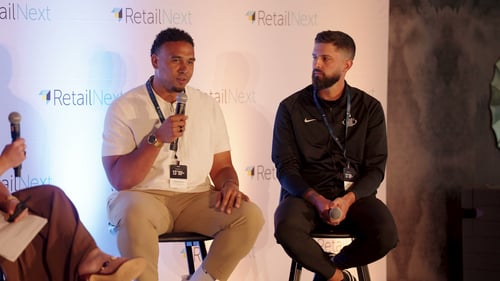
Michael Saldaña, UNTUCKit’s Senior Retail Operations Manager, attributes much of the brand’s success to its commitment to analytics. Starting as a store manager in 2018, Saldaña witnessed firsthand the transformative power of data through RetailNext, a platform providing real-time insights into shopper behaviors. By tracking key performance indicators (KPIs) such as traffic, conversion rates, and sales, the platform enabled teams to make informed decisions that optimized store performance.
As the company scaled, data’s role grew. Market managers began analyzing store layouts and labor models, identifying areas for improvement. For instance, footpath analysis in stores like Mall of America revealed traffic patterns that informed staffing strategies and visual merchandising.
UNTUCKit also integrated data-driven practices into its operations culture. From onboarding to monthly training sessions, employees are equipped with tools to interpret and act on data, fostering a proactive environment. End-of-day reports combining qualitative and quantitative feedback ensure continuous refinement.
Looking ahead, UNTUCKit plans to sustain this momentum as it opens new stores and deepens its understanding of in-store shopper behavior. By pairing data insights with customer engagement, UNTUCKit exemplifies how physical retail can thrive in the digital age.
GET THE CASE STUDY: How UNTUCKit Drives Conversion In Its Stores
Hi, everybody. Good afternoon, welcome to The Pulse a series of thought-provoking conversations with leading retailers and industry experts on the state of retail today. I am Joe Shasteen I'm the Global Manager of Advanced Analytics at RetailNext. A little bit about RetailNext, we're the first vertical platform to bring e-commerce style shopper analytics to brick-and-mortar stores, brands and malls.
And pioneers in focussing entirely on optimizing the shopping experience. Our centralized SaaS platform automatically collects and analyzes shopper behavior data distilling that into insights retailers can use improve the shopper experience in real-time and at scale. We are The Pulse of The Store which more than 450 retailers in over 90 countries have adopted and come to trust. And I'm very excited today to have Michael Saldaña with me.
He is the Senior Retail Operations Manager at UNTUCKit. He has succesfully implemented practices to streamline workload and enhance operational efficiency. And is commited to delivering quality results and the best experience to customers and store associates alike. So with that I'd like to just jump right in and talk about brick-and-mortar and how retail in brick-and-mortar locations is alive and well.
It could be a competitive advantage for brands. As a digitally-native brand such as UNTUCKit, How did your journey with installing physical stores and opening physical stores begin? Yeah, thanks for the intro, Joe. It's good to be here.
UNTUCKit was founded in 2010. We are a digitally native brand. We opted to open stores starting in 2015, our first store was opened here in New York City in Soho. The motivation to open the store was very simple, the customer simply wanted to touch and feel the product.
And it just made perfect sense to open up that shop where they could come in and do just that. And get their hands on the product first hand. That was in 2015, we now stand at just over 80 stores now. With a footprint in the United States, from Philadelphia to Portland, we're in Canada, and we're in th UK.
It's good stuff. No, that's great. You've really been great at positioning your physical stores for success. Can you tell me a little bit more about your journey when you started at UNTUCKit with only about 25 stores.
And now like you said its expanded to over 80. So can you talk a little bit about your journey particularly at UNTUCKit as well. Yea, I was the guy on the ground. I was a store manager in 2018.
I was running our store out in Pittsburgh and at the time, RetailNext at a store level was simply a way to help coach your team to identify KPIs on the ground and make that real-time change, you could facilitate coaching conversations based on the data that you're able to find. And it also fostered healthy competition. When you're talking through with looking at the data against other locations nearby. I was promoted to be a Market Manager in 2019.
And that was a game changer. You're now looking at comparing stores. Getting stores to look at other stores for benchmarking purposes. One very distinct one, I opened our stores in Cleveland and Memphis.
Very different geographical footprint but, in the centers themselves, were actually quite comparable. Both outdoors, more intimate, like, lifestyle centers. And so these stores shared a lot of KPI overlap that allowed for them to build upon each other to collectively build their business. In 2021...
In 2021... No. 2022. Excuse me.
I moved into the ops role. It's a whole other experience here. Now it's not so much being the person on the ground trying to foster and make that change directly like from a sales-driven perspective, but more optimization of process And trying to build that culturally at UNTUCKit, not that it already isn't. No, that's actually great point that you mentioned and UNTUCKit has been one of our best-in-class customers.
At really generating the data and driving it into your daily operational use. Kind of creating, like you just said, that culture of data, you know data-driven culture. Data, you know, data-driven culture is something we like to talk a lot about. So could you talk a little bit more about kind of generating that data-driven culture how you started to bring the data into, daily decision-making, and any examples of that as well?
Yeah, it starts on day one. Like, we incorporate RetailNext training and that data understanding with our store team during employee onboarding. And that's intentional to get them to understand that you're not just going to get some flash report that you can't modify, that you really can only use one time. You're going to be able to use this and filter in real time down to the hour and see how you're comparing against your peers.
So we foster that culture right from the get-go, that it's at the fingertips of everybody in the stores. Our L&D department also fosters these open offices with the retail engagement manager here at RetailNext. And that allows us monthly to, you know, get a pulse check on where stores are at if they need help working and maneuvering through. But it also allows for us to bridge and bring some of those things up to bring some of these newer initiatives to the stores on an ongoing basis.
So it's not something that we just kind of set at the beginning. We're keeping it alive consistently. Yeah. So that's really great to hear.
I mean, I know that our partnership has been impactful as you've been using the data and bringing it more into, you know, all decisions that are being made. Would you be able to discuss some of the decisions, maybe some of the tests that they've made using this data to kind of walk us through some of that process a bit and some of the impacts on your business? Yeah, absolutely. So our market managers are a great use case.
They use the camera footage alongside the data analytics. to meet with their store managers to talk through behaviors that they're seeing in the stores. They particularly will hone in on, like, weekends, like what does coverage look like? What are those behaviors on the ground during the weekend?
And what we use with that is to excuse me we use that to get an understanding of how our labor model fell into play with like, how we were building schedules. And from this, we learned we were understaffed, frankly. Like, we needed more people on the ground. We needed more people to cover the traffic flow that was happening in the store.
So the market managers were able to identify this very readily with meeting with their store teams and then they were able to give us that ammunition to make those changes, which then, you know, allowed for us to maximize our coverage, build our conversion, and, you know, that would have not been possible. The importance of this data to make those decisions at the high level was so crucial. That's great to hear, too. So kind of the transition from, you know, e-commerce into brick-and-mortar, you know, can be challenging, right?
How do you analyze a brick-and-mortar store when you use e-commerce and all the data that comes through? So, again, RetailNext is a great way to provide that. But what were some of the kind of challenges or some of, you know, to create that measurable environment in your stores? You know, what was that process like working through that?
I think a lot of that has to go back to, you know, when we first started with stores, our store in Soho was around for a couple of years before we opened the next outpost, and from there, the scale happens. And when you start with such a small fleet of stores, and you really only are, for the most part, you're relying on this mountain of data that's coming from e-commerce, you... We grew to be a little bit reliant on that... that qualitative feedback that you'd get from a store, which, you know, can be very anecdotal, frankly, and doesn't have as much substance to take that action.
And it's also, I think, one of those things where when you're on the ground and you're experiencing something over and over and over, it may feel over and over for you, but to scale it really isn't and so to make that change in the bigger way, isn't all that great. What we wanted to do was find a way to get that qualitative feedback and mirror it back with quantitative data. So what are you really seeing on the ground? We were able to integrate, like, metrics for counting traffic effectively, right, but then also baseline metrics.
What is a viable conversion for us? What is a viable AOV, a UPT, right? And then from there, we're also able to trace the shopper journey. It's wonderful.
So we have these baseline KPIs, right, for all of our stores, and how we compile that and kind of bridge it together is through end-of-day emails. We ask our stores to go into the RetailNext platform and tell us, where did you land end of day in all those baseline KPIs? And on top of that, give me a fun FUNTUCKit fact. Give me what you really saw.
So maybe we can see that your traffic was inflated, and you're going to tell me it was probably because of some event that happened in your city. Or the other way, maybe your conversion was really low. Maybe you saw a lot of group shoppers. So it's a great way to combine both of those things together.
Great. That's incredible to hear. I mean, I'm always really interested in hearing about how customers are able to really drive impactful business decisions through using that data. You mentioned a little bit about understanding interior data, right?
So what are people doing inside your store? Can you talk a little bit about any projects that have been done trying to understand a little bit more about customer experience? Yeah. Yeah, absolutely.
Can I call you out? You were the one who helped me with it. We were working on an FPA, footpath analysis. What that is, really, at the front of every store, there's a small camera that will, you know, see the customer flow going in and out.
You essentially put those throughout the store, and it maps, like your sales floor so you can see where that footprint from the store from the customer, begins at the start, the entrance. And as they navigate through, where do they land and what parts of the store do they touch until they leave? We did this at two stores. We did one in Chicago and one in Mall of America in Minneapolis.
And really what we were motivated to understand is, you know, where does the customer ultimately land in our store? Does that change if we make changes to our fixture overview, to visual presentations? You know, what is that? And we did have, I think, some introductory data that showed us that customers were already organically going in one direction or the other.
So we did it over the course of two visual cycles, essentially. Like, do we see that change? And, long story short, no. But what we did learn, what we really did get out of that, was that we saw there's heat where the customers are trafficking regardless.
I think our stores are, frankly, kind of small, they're boutique-style. So, you know, there's not as much of a wiggle room for them to go in different places. Like, that's kind of baked. But where they ultimately land is how do they sync up with the store associate.
So that same footpath, like, that we were using to track the customer was also what we were using to see where the store team was landing. And in doing so, we were able to see where is that overlap. And there were some interesting discoveries there, too. Like, Mall of America is a tourist area, so chock-full of group shopping, there were heat spots where we would see that there's a bunch of customer flow but, like, not so much the store team.
Like, we didn't see them really going there. And on the ground, that's because there's one wallet for a group of six people, and these other six people are in these other parts of the store. So they're not getting the same engagement, but they're not the primary shoppers. So very, very captivating to see how that all shook out.
Yeah, and then you've also mentioned in the past that you used the data to kind of change some of the store operations on the staff side of things. Can you discuss how you've used some of the, you know, full path of the traffic data to make those changes as well and implement, you know, positive changes for your business? Oh, yeah. So we took that and, you know, made...
We already have a training regarding, like, selling models and how we expect the store teams to approach the customer through various, like, types of customers understanding and greeting the room, right? But the improvement there was about understanding and identifying, like, that customer that is ready to shop and knowing when to approach understanding how to handle and maneuver the group shopping. We have seating areas in most stores, so if you engage that group to be there to help them when they're helping build the sale with the customer that they're shopping with versus letting them just leave the store, you know, being the conversion killer if you will. Yeah, I mean, those are some really powerful examples of how you can use the data to help inform store operations, you know, scheduling, payroll, customer experience, all those different ways that you can use the data to impact changes in the stores themselves.
But again, I think a lot of that is, you know. Some of the work that you've done to really help operationalise that. But I also want to talk about a little bit more into the future, so what is kind of next for you? What is next for UNTUCKit with more physical stores as well as, you know, potential more analysis of behavior inside those stores?
Yeah, well we're opening seven stores this spring so that's pretty cool. Uhm, I think what we're going to do, we're going to stick to what we know right? By having this data-driven culture in the stores, right? Already built in with employee onboarding.
We're going to keep that up and we're going to set these stores up for success. these seven new stores are going to be a great way to relaunch that. So we'll have the structure to ensure that, from day one they have the tools necessary to increase their business acumen and know how they build upon it in these established markets. Great.
Well, thank you so much, Micheal. I really appreciate having you up here. So thank you so much for all your enlightening discussion today of how you're using RetailNext data both traffic and full path as well.
Talk to our team. We'll show you exactly what RetailNext can accomplish for your business.