[Opening montage from the Executive Forum sizzle reel.]
Alright. Welcome everyone. Today we'll learn things about retail in all different capacities. Retail done badly is the worst business in the world. What AI will never do is replace that human connection which we value so much. Conversion was that metric that we tied to as performance.
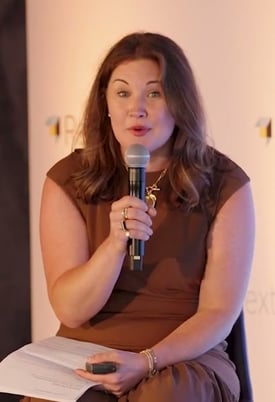
Gabrielle Curione: Hello. Nice little wake up after lunch. I'm Gabrielle. I'm an account director here at RetailNext, and I'm thrilled to be with my partners, Dre and Joe at Foot Locker. Today we're going to just be digging into how data analytics really impacts the whole business — whether that be day-to-day operations, whether that be the reimagined stores and the investments that they're making in upgrading the fleet, and events too. So I'm very excited to dig in. I loved working with these guys. Also helps that we all have Philly roots. So go Birds.
Andreas Derkits: Go Birds.
Gabrielle Curione: Where we at? There he is. I know. I know. Lot of Forty Niner people here.
Andreas Derkits: Boo Niners. Giants.
Gabrielle Curione: But I'd love for you guys to give your background. I think after meeting so many people at Foot Locker, roots really run deep, and you guys have a great journey story. So I'd love for you guys to share.
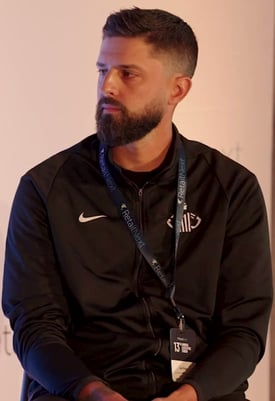
Andreas Derkits: For sure. For sure. First of all, excited to be here — great first day. I know we played golf till about eight o'clock last night. We showed up a little late right off the golf course. So, Andreas Derkits — you can call me Dre. I've been with Foot Locker 18 years, so it'll be 19 years in December. I started as a part-timer in 2007. My cousin got me the job. I was unemployed at the time. I got fired from GNC — I'll tell you guys that story later. But my mom was like, “Hey man, what are we doing here?” I was going to school for basically occupational therapy at that point, and I started part-time, was assistant manager full-time, and then store manager for about six and a half years. And I was a district manager for five years in the field, so overall field experience has been about 15 years in the field collectively. And then two years ago I took the transition to the corporate side, and I got to work with this guy to my left. I was Senior Manager of Customer Experience for North America, so really driving technology and initiatives and just CX strategy and behaviors within stores. And then most recently I came to the banner initiative side. So currently I'm Director of Banner Initiatives for North America, so I support with store technology initiatives, really strategy and where we're going from a technology perspective, capital projects, investments, and really supporting my banner partners to bring the experience to life for our customers. Joe, over to you. And our two handicap — he needs some golf lessons.
Joe Keen: Hey, seriously. I'll take everything I can get. So, yeah, those lights are bright. I know. We're talking about lighting. First, I think it's funny you bring two store guys in to talk about data. But similar to Dre, I've been with the company 15 years. I started in stores as well. Never thought I would be in retail. And I think it's so cool to hear a lot of the conversation earlier just about pouring into our teams. And that's our secret sauce — we call our teammates Stripers in store. And you see in the video just how we bring things to life. So I started in store part-time, was walking through the mall, going to school, and I was like, “Wow, Champs Sports, I love the stuff they sell.” Walked in, I said, “Guys hiring?” He's like, paper application — times have changed. He said, “Can you start tomorrow?” And fast forward, I was in stores, ran all different leadership roles in stores for seven years. And then transitioned to the corporate office where I've done everything from store operations to our teammate experience, communication. And now most recently and currently Senior Director of Store Experience, which has two arms under it. One where I'm focused on the customer experience strategy — so our Striper behaviors, how we interact with the consumer, working with Dre, what technology we need to put in to make that customer journey smooth and efficient. And then the other side of my org is execution. We know right now in retail we've got to execute at a high level, so I have teams across North America where we're out there on new store, CapEx projects. We roll out a new initiative, we're helping develop, coach, and train to any new initiative. So thanks for having us.
Gabrielle Curione: Yeah. No, I'm very glad that you're here. A little bit about me. So I'm an account director here. I've been here seven years. Nine years ago I attended as a customer with PVH. I worked with Darren on his team. So very full circle that we're all back together when we talk about human connection. I mean, that's, I think, a big benefit of RetailNext. As a salesperson now here, I many times have to really sell — you know, I'm selling cameras, right? But I'm really selling what the value of the data is, and that is conversion. And the refreshing part about working with these guys is they were already on it. I did not have to sell the value. They were actually in the field bootstrapping a culture of conversion themselves with pretty terrible data, to be honest with you.
Andreas Derkits: Extremely terrible.
Gabrielle Curione: Yeah. I don't want to take away from the story, but I want to kind of go back. It was like 2022, you guys actually started this bootstrapped program on increasing conversion. I kind of want to start there.
Andreas Derkits: Yeah. It was a long journey for sure to get to this point, Gabby. I know we started with Varun as Gabby was having her little one, and they were like, “Is this Foot Locker thing ever going to happen?” Trust — Joe and I were fighting on the back end to make it happen. Like, trust and believe. But yeah, man, we've always been focused on driving KPIs. I think that's our selling culture in store and connecting to the customer shift, but also tying it back to what behaviors are driving what results, right? And I think we did a lot of things to focus on conversion. And in 2022, post the COVID — I think we called it after COVID, right, AC — we really started to dive into our omni behaviors, and how do we get a mindset from our Striper that's always on, never know, and driving the customer experience. And conversion was that metric that we tied to as performance and really using that KPI. That was, like, the number one KPI. So when we looked at our traffic, we said, okay, this is a critical piece of the business. How many people are coming in? How are we getting to them? How are we driving that KPI consistently? And we felt good about ourselves because we're like, “Hey man, we got gains in conversion.” And even though traffic might be down, we're up in conversion. There was always this kind of, if you had a conversion gain, even if you missed a day, you had a good day, right? But then we started to see things. We're like, man, we had a lot of issues with our legacy vendor. I'm like, man, these cameras are like flip phones from 2000. You know? Like, if you had a flip phone right now that didn't have a smart screen or touch screen, you'd be looking a little sideways. And that's how our camera technology was in stores. So we started to explore, and RetailNext came to the forefront. And working with Gabby and Varun and the entire team has just been incredible, and it really helped us understand, like, man, we've got to make an investment here, and we need to understand how we can truly leverage this data and trust this data. And that's where we really started. And we did a POC in ten stores, and the variance from store to store was extremely significant. I'm talking, some stores, we're reporting, our legacy account isn't reporting this, and RetailNext is reporting almost 30% different variance in traffic. And that allowed us to start to tell this story of, okay guys, we talk about traffic on every single call, every single week, every single month. We're making business decisions off of the traffic and the conversion results that we have, but the data we have is inaccurate. So therefore the decisions we're making are inaccurate. So leveraging the technology through RetailNext and going through the journey of, okay, testing it out — and then something unprecedented happened. We got the approval to go forward in December. In peak season, on the corporate side, a lot of people take it off during the holidays. So we're trying to figure it out, and this team was incredible to get us to the point that, hey, we're ready to go. Then in 60 days we rolled out from January to, we'll call it, the end of February. We rolled out RetailNext to every single store — 1,400-plus stores, we'll call it 1,500, in North America. And this year, obviously, going through the transition of what that looks like. So it's been invaluable. The data we can trust. Now it's getting the team to start to go through that transition period of this year, because they don't know how to survive without comp conversion right now, right? But helping them through that transition, and even just the data side that Joe and the team has provided us to really help educate our leaders through this transition and helping them really use this data more effectively. And then the ultimate unlock is our transition with Shopper Yield, I think. So that was a metric that RetailNext kind of introduced us to. UPT, dollars per transaction, conversion — those were our key metrics. Obviously some of our voice-of-the-customer metrics, but those were things that we looked at consistently. And the idea of having a value or a metric or a KPI that includes all of those things in one was just so valuable and simplified. That's been really our strategy for our store teams — let's simplify the message. And we call it customer value, but Shopper Yield allowed us to simplify and say, hey, total sales divided by total traffic. What's the dollar value of every single consumer walking into your store? And how do you maximize that with one extra sale, or with one extra unit within that transaction, and collectively looking at ways to drive value within the day-to-day business and within our stores. So it's been a tremendous transition. I appreciate all the partnership.
Gabrielle Curione: Yeah. No, I mean, that was a plug there for the partnership. But I just think you guys have been really smart about — you had this kind of coaching that existed in the stores. So we really were able to amplify it with getting data in every store. And then you've really taken to Shopper Yield, especially in a time of transition, right, when we don't have that comp. It's been really smart, and we've been working with the stores in that way.
Joe Keen: If I could just add to it — the 15 minutes for Dre is never a good thing.
Andreas Derkits: No, it's not.
Joe Keen: Just the accuracy, and now having integrity in the data, is going to be a huge unlock for us. We know our most important asset is our frontline team and our Stripers, and how do we get them more — I think it was just said in the last presentation around getting our team more customer-facing, get off a task. So how are we scheduling to that demand and that traffic, and layer in the behaviors that Dre talked about. I mean, we're seeing positive growth on it.
Gabrielle Curione: Yep. Yeah. And we've also done quite a bit on measuring all the ROI on the investments in the store. So as you have these new concepts and designs, what is it actually doing to the shopper journey? Is it a go-forward? Is it moving the needle in business? So there's just a couple of comments you wanted to share on some of the learnings that you've had from customer journey data.
Andreas Derkits: Yeah. I think it was instrumental. So if you guys follow Foot Locker at all, take it back to late 2024. We opened three — like a reimagined concept, if you would. Really stripping the store back and thinking, how can we do something different for the sneaker community. And we had ideas like, hey, let's try to have this communal try-on, like a campfire — if you think, sitting around a campfire having a drink. But, hey, everybody, sneakerheads coming together in the heart of the store, being at the heart of sneakers, and trying on together. And you know that influence between each other. We thought it was an amazing idea. But we installed heat mapping, and we looked at dwell times, and we pulled all the seating to the center of the store. We called it the Kick It Club. And we realized quickly the customer didn't want it. They wanted to be still on the footwear walls where they're discovering product while they're trying on. So we quickly pivoted from that. There's multiple examples around product when you talk about visual merchandising — how impactful are our front fixtures, and what's that halo effect to the brand itself? Or, hey, Joe — where's Joe? Joe's the man, data guy — really just looking at, hey, where can we take some commercial space from and give it to high-performing brands, to scheduling to the demand. So I think the heat tracking, or the heat mapping, the dwell times, was instrumental to landing our current store format, which we're rolling out hot and heavy now.
Gabrielle Curione: Yeah. I always think it's that refinement period, right? And people sometimes want these big wins, but a big win, to be honest, is sometimes some CapEx savings, right? Where you think you're going to do this massive change to the store and actually it's not worth the investment. So definitely some really solid learnings. I'm more excited to see kind of the version 2.0 here. A really interesting application of our data, which has been new for us, is physical events — physically outside an arena with the NBA All-Star game this year. So that was a really cool opportunity. So just wanted to really understand how traffic data really impacted the event for you guys.
Andreas Derkits: Well, you guys see in the video, there was a lot going on at All-Star. So if I can paint the picture: with our vendor partners, we had Nike, Jordan, and Converse outside, basically on top of a parking garage. And then you came down and it was Adidas, Puma, and our other strategic partners on the outskirts. So you had about four or five entrances collectively where the consumer could navigate between these experiences. And so it was extremely complex, and ultimately we needed to understand, where was the customer going throughout these experiences? How much time were they going up here, coming down here? What drove more traffic from an event standpoint? Obviously a ton of people coming through, so where was that traffic going, and obviously connecting it back to sales. So we were able to get conversion out of that data as well. So RetailNext — we worked extremely quickly to kind of add cameras outside on both entrances on the top of the parking garage, and then on the frames outside as well. So we were able to capture all of the consumer journey throughout both spaces. And really, over 24,000 people walked through and experienced our All-Star event, and really allowing us to say, okay, how do we drive this further? Even in the future — we've struggled in events in the past to say, year over year, how do we build on it? How do we get better? And data helps you do that. Data helps you analyze what worked, what didn't work, and helps you make better business decisions. So having that data available as we go forward into future years will allow us to create better events for our consumers and drive better connectivity with the community. So it was really an unprecedented quick turnaround, and an outdoor event.
Gabrielle Curione: We didn't expect that we'd have had some content. Yes. So it worked really well to help us bring the event together. That was three minutes, Joe.
Joe Keen: I know. We actually are cruising through this.
Gabrielle Curione: Record time. We at least got an hour, Joe. I don't know what happened. I mean, with this one, I think we can kind of open it up. We just wanted to kind of touch on all of the different areas that we do use data in. It's different facets of the business.
Joe Keen: Yeah, I can add in too. I think we were talking about it a little bit over here, and it's cool to think and hear all the AI conversations, because where we're at with it now — and speaking of data — is again getting our Stripers more customer-facing. How are we extracting data? And then our internal joke is we have a dashboard for everything. So our store teams don't need to be diving into the data and taking hours in the back room. They need to be on the sales floor. So we're using it almost like an AI genie, if you will, to where I can go in as a store manager and say, hey, what are my top-selling SKUs? Make sure they're represented on the sales floor. What's the depth in it? Do I need to work with the product team to get more? Hey, what's my conversion trend? Or what's my traffic trend? So I think we're using it more from an efficiency standpoint in stores. So it's great to hear. And I think the biggest thing, and just the similarities of all the presentations — we're big on three things. We say we build a culture that our teams want to be in and they want to be around. It speaks in the tenure. If you talk above store, our tenure is like 20-plus years, 22 years. So we build that culture, we develop them. We take the time and we pour into our teams. We build their capabilities, whether it's technology, whether it's product, whether it's whatever it may be — career pathing and growth. And then we have a strategic plan around behaviors and execute at a high level. And that's really what our secret sauce is to drive performance through data.
Gabrielle Curione: Awesome. Well, thanks guys.
Joe Keen: Yeah. Thank you guys. Thank you very much.