How many different systems are you using to measure what happens inside your stores? And of the data they collect, how much is actually reaching the people who could act on it — your store associates, your district managers, your operations team at HQ?
If neither answer sits well, you are in the same position as most enterprise retailers. The stack grew one decision at a time: a point solution for door counting, a workforce-scheduling tool running its own traffic forecast, a legacy CCTV system still owned by Asset Protection, and systems inherited from an acquisition that nobody has had time to migrate. Now the data does not connect, the maintenance burden is real, and nobody has a unified view of store performance.
This is not just a retail IT problem. ADAPT Research reports that more than two-thirds of technology leaders planned to consolidate tools in 2025, most targeting a 20% reduction in vendor count. And the goal is not simply fewer vendors — it’s landing on platforms that meet enterprise requirements, like SOC 2 compliance. You’ve been living with these dynamics for years.
Consolidation projects have a real cost, but so does deferring them: some costs appear in the IT budget, others in the form of lost productivity and weaker decisions.
The Price Of Fragmentation
The direct costs come first: licensing, integration maintenance, vendor management, and the engineering time required to keep disparate systems talking.
McKinsey frames this kind of fragmentation as tech debt, and like financial debt, it has a principal and an interest payment. The principal is the modernization work outstanding: the rebuilds, the data harmonization, the integrations that should have been retired. McKinsey’s CIO survey puts that at 20-40% of the total value of a typical technology footprint. The interest is what every new project pays in workarounds and fragile point-to-point integrations to keep legacy systems behaving — 10 to 20% of new product budgets, with more than two-thirds of CIOs reporting they pay over 10%. Plus, 60% say the burden is growing, not shrinking.
For a large retailer, that is real capital not going to innovation.
The less visible cost is the quality of decisions made on fragmented data. Forrester found workers lose 12 hours a week searching for information trapped in silos. Gartner estimates that poor data quality costs large organizations millions each year. In retail, those hours belong to the analysts and operators who should be driving performance, not reconciling reports.
What Consolidation Buys You
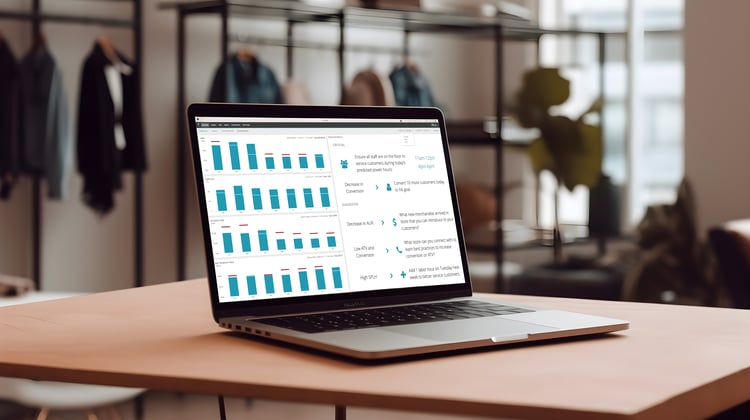
Store managers don’t care about traffic counts or dwell times in the abstract. They want to know whether the new window display brought more shoppers inside, whether the floor reset improved conversion, and whether their team was staffed for Saturday’s rush. When shopper measurement is unified, those questions get answered in the time it takes to run a report — not the time it takes to reconcile multiple systems. Stores become genuinely comparable across a portfolio, and anomalies surface in real time rather than in next week’s report.
Just as important, a single platform serves all stakeholders from a single source of truth. Associates and store managers see how they’re tracking against their conversion target in time to act, not read about a miss in tomorrow’s report. District and regional managers compare locations side by side without stitching spreadsheets together. HQ gets the consolidated executive view across the portfolio without chasing multiple vendors for inputs. And the same data foundation powers RetailNext’s Insights capabilities, which analyze complete shopping journeys and the interactions between staff and shoppers — the kind of behavioral analysis that is structurally impossible when your data is split across multiple systems.
Every retailer already has cameras. Asset Protection has owned them for years, but when video sits on the same platform as the analytics, that footage becomes an asset for operations, merchandising, and HQ, too. Why is hourly conversion dropping at the same time every week? The detailed analytics tell you where to look: the queue that formed during the lunch rush, the fitting room that sat unused because no associate was there, the window display that drew a crowd. It won’t replace a store visit, but when travel budgets are tight, it’s invaluable.
You Will Always Have Multiple Systems
Consolidation doesn’t mean settling for one vendor’s take on every category. The best-in-class POS, workforce management, BI, and merchandising systems you’ve already chosen aren’t going anywhere. The question is whether their data lands on a platform that operators can actually use. One user-oriented layer that pulls those outputs together drives more impactful decisions than any number of disconnected systems — no matter how good each one is on its own.
For CIOs and CTOs, the architecture question worth asking is whether your current footprint generates compound value over time, or compound complexity.
AI Needs A Foundation
AI is the newest imperative competing for retail IT budget and attention — and the one most dependent on the consolidation question. Retailers are seeing real benefits beyond the hype, but many factors determine the true ROI: are you overpaying for complex AI to compensate for scattered, unreliable data, and how do you really know it’s improving store performance and customer experience?
Low-quality data compounds the AI bill. Duplicated or inconsistent inputs mean AI services do more work — and retailers pay more to get a valuable answer. A consolidated data foundation gives every AI initiative cleaner inputs — and a smaller bill. Gartner has warned that through 2026, organizations will abandon 60% of AI projects that aren’t supported by AI-ready data.
That foundation also answers the question that comes after deployment: Is this AI actually working? Every vendor has a demo and a case study. Few retailers have the independent, objective data to verify lift — did the forecasting model reduce stockouts, did the recommendation engine lift basket size, did the personalized offer improve repeat visits? Connected operational data answers those questions honestly, store by store, against a real baseline. The retailers building AI-powered operations today started by getting the underlying data right.
Consolidate With RetailNext
RetailNext was designed to be that foundation. The platform unifies traffic intelligence, shopper journey insights, and store performance metrics in one environment, with native integrations to the systems retailers already run. It scales from global chains with thousands of stores down to brands opening their first, and it handles the cases where consolidation projects usually stall: multi-region portfolios on different stacks, acquired banners that arrived with their own legacy systems, corporate teams driving a single global standard across all of it.
Customers consolidating onto RetailNext typically find that the architectural simplification alone justifies the move. Maintenance drops. Governance becomes manageable. And the range of analytics that operators and executives can actually act on — merchandising tests judged in days instead of quarters, staffing models rolled out globally from one feed — increases because the data is finally connected.
For US enterprise retailers, RetailNext also offers hardware replacement options that reduce the capital cost of moving off legacy counting infrastructure.
The retailers furthest ahead analytically are not running the most tools. They are running the right ones, connected, on a platform built to scale.
EXPLORE FUNDED DEPLOYMENT FOR ENTERPRISE 👉 A New Era In Store Analytics Awaits